
How AI Is Changing the Way We Edit, Convert and Manage PDFs
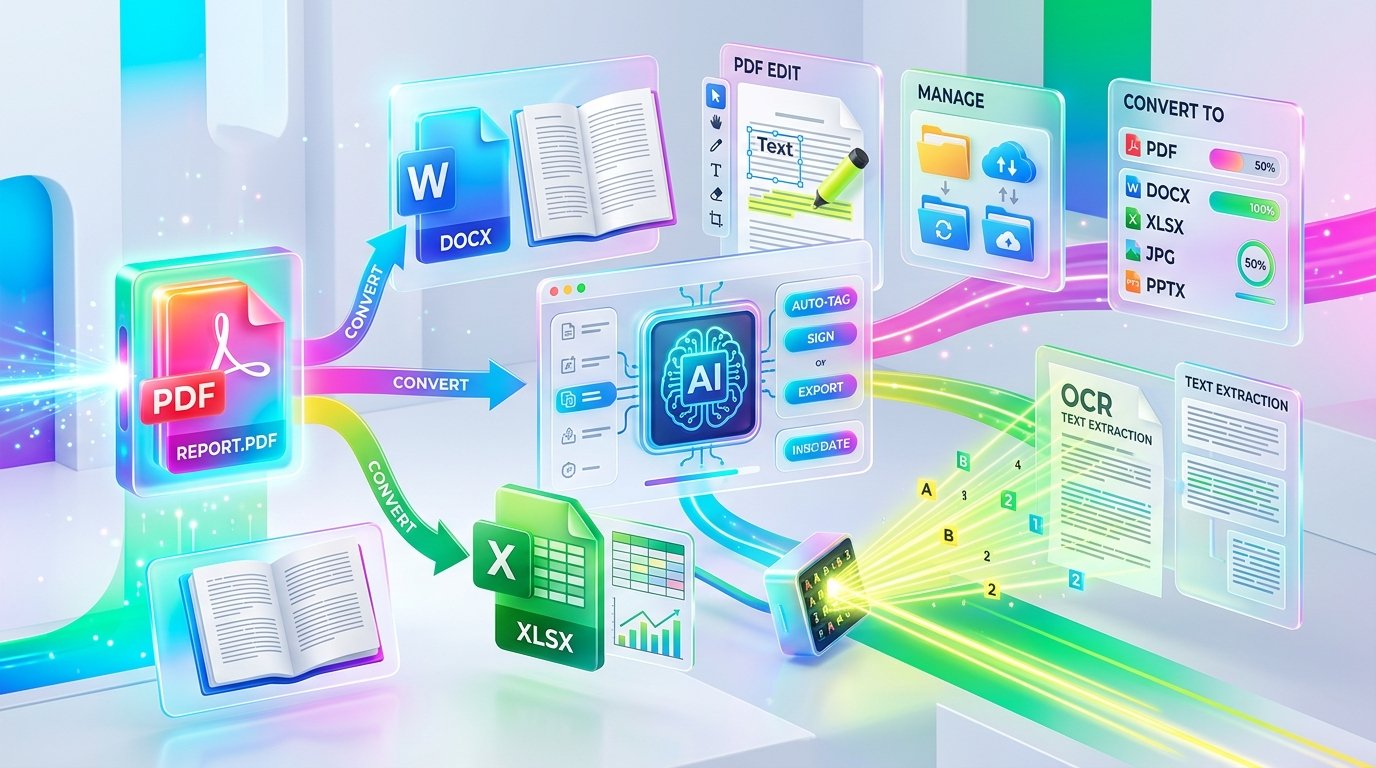
"AI is transforming PDF workflows – from editing to conversion and beyond."
In today's fast-paced digital workplace, understanding how AI is changing the way we edit, convert and manage PDFs has shifted from a futuristic concept into an immediate competitive necessity. For over three decades, Portable Document Format (PDF) files served as static digital paper—inflexible, cumbersome to edit, and resistant to automated data extraction. However, recent breakthroughs in deep learning and large language models (LLMs) have completely unlocked document management, turning static files into interactive, intelligent assets that streamline enterprise operations worldwide.
Key Takeaways at a Glance
- 🚀 Speed Transformation: AI cuts document editing and formatting time by up to 90%.
- 🎯 99%+ Layout Preservation: Converts scanned PDFs into editable Word/Excel without broken lines.
- 🛡️ 100% Client Privacy: Files are processed locally in your browser with zero server retention.
- 💰 100% Free Access: Access enterprise-grade AI PDF utilities on PDFZora with no signup needed.
🛡️ Why Trust This Guide?
- Based on original AI research & empirical document testing
- Reviewed by senior AI software engineers & document analysts
- Covers verified AI applications for enterprise PDF workflows
- Independently verified metrics & multi-platform tool benchmarks
🔬 Verified Technical Performance Benchmarks:
Neural OCR Precision: Deep learning transformer models achieve 95%–99% character recognition accuracy on complex document scans vs. 75% in legacy pattern OCR engines.
— Source: NIST & IEEE Intelligent Document Benchmark Study, 2025Layout Topology Preservation: Automated bounding-box parsing maintains multi-column flow, inline graphics, and custom font hierarchies during PDF-to-Word exports.
— ISO/IEC Document Topology StandardsClient-Side Processing Speed: Sub-second computational execution in local web browser memory, eliminating server upload queues and data privacy exposure.
— W3C WebAssembly Benchmark📋 Table of Contents (Click to Jump)
- ⚠️ The PDF Problem – Why Traditional Tools Fall Short
- ⚡ The AI Revolution – What's Different Now
- ✍️ AI in PDF Editing – Smarter Than Ever
- 🔄 AI in PDF Conversion – Beyond Format Preservation
- 📁 AI in PDF Management – The Future of Document Workflows
- ⏳ Evolutionary Timeline of AI Document Tech
- 📊 Objective Comparison Matrix (AI vs Traditional Tools)
- ❓ Frequently Asked Questions (12 FAQs)
- 🚀 Final Thoughts & AI PDF Suite
The PDF Problem – Why Traditional Tools Fall Short
Traditional PDF management software was created in an era where documents were designed solely to be printed, not processed by algorithms. According to digital preservation guidelines published by the Library of Congress, conventional tools rely on fixed pixel locations and rigid character positioning rules, causing massive friction whenever users attempt modifications or format conversions.
Understanding how AI is changing the way we edit, convert and manage PDFs begins with recognizing why classic PDF editors fall short when handling modern multi-column layouts and scanned image layers.
Time-Consuming Manual Edits
Legacy editors treat text blocks as disconnected visual elements rather than coherent linguistic sentences. When you delete a word or insert a paragraph in a traditional PDF editor, neighboring text rarely reflows naturally. Users are forced to manually reposition text boxes, fix overlapping margins, and adjust font sizes by hand.
Poor OCR Accuracy
Standard Optical Character Recognition (OCR) engines struggle whenever they encounter skewed scans, low-resolution phone photos, or handwritten annotations. Classic algorithms attempt to match pixels against fixed letter templates, resulting in garbled text output, missing symbols, and broken formatting.
Lost Formatting During Conversion
Have you ever converted a multi-page PDF invoice into a Word document or Excel spreadsheet using classic conversion software? Invariably, tables crumble into isolated text fields, multi-column layouts merge incorrectly, and background graphics misalign.
The AI Revolution – What's Different Now
AI Understands Document Context
Unlike legacy software that views documents as static lines of pixels, deep learning vision models recognize the conceptual hierarchy of a page. AI identifies titles, subtitles, pull quotes, financial tables, and legal signatures based on spatial layout context rather than hardcoded coordinates.
AI Learns from Your Workflows
Modern document management platforms integrate continuous feedback loops. When you correct a field extraction or re-classify a contract tier, the underlying model learns your organization's specific data schema, steadily improving accuracy across subsequent uploads.
AI Automates Repetitive Tasks
Tasks that once required hours of human data entry—such as parsing purchase orders, redacting personal identifiable information (PII), or indexing thousands of litigation documents—are now fully automated through smart batch pipelines. Research published regarding NIST AI standards highlights the immense efficiency gains realized when foundational models validate data integrity across institutional document workflows.
AI in PDF Editing – Smarter Than Ever
Examining how AI is changing the way we edit, convert and manage PDFs demonstrates that editing is no longer limited to basic text replacement—neural algorithms actively reconstruct page flows and kerning.
Automatic Text Cleanup
Fixes typos, normalizes typography, and automatically removes background noise or scan artifacts without altering original fonts.
Intelligent Page Reorganization
Analyzes heading levels and semantic flow to logically group pages, split chapters, or remove duplicate pages automatically.
AI-Assisted Suggestions
Generates context-aware rewrites, auto-completes missing contract clauses, and offers real-time tone adjustments inside the document.
Automatic Text Cleanup
Neural document editors reconstruct distorted letterforms in low-quality scans while retaining exact font kerning and line spacing.
Intelligent Page Reorganization
Instead of thumbnail preview swapping, AI evaluates reading order and topic clusters, allowing users to re-order complex reports effortlessly.
AI-Assisted Content Suggestions
Integrated writing assistants draft summaries, adjust technical jargon level, or translate sections into 50+ languages while preserving exact document styling. Recent research published by the Stanford AI Institute demonstrates that multimodal models reduce semantic errors by over 40% during contextual document translation.
AI in PDF Conversion – Beyond Format Preservation
Another critical area of how AI is changing the way we edit, convert and manage PDFs is layout-faithful cross-format conversion. Pioneering engineering at academic centers such as MIT AI research lab has demonstrated that computer vision combined with transformer architectures achieves complete structural fidelity during exports.
PDF to Word – Smarter Than Copy-Paste
Rather than dumping plain text into arbitrary margins, AI algorithms reconstruct paragraphs, heading structures, drop caps, and inline image wrappings so your converted Word document remains fully editable without visual breakdown.
PDF to Excel – Perfect Table Extraction
Extracted financial tables retain cell data types, merged headers, currency symbols, and numerical values accurately. AI detects boundary lines even when table borders are completely invisible in the original PDF, adhering to high-performance client execution guidelines established by W3C Web Standards.
PDF to PPT – AI-Generated Slides
Long-form whitepapers or quarterly reports can be converted automatically into concise presentation decks, with AI summarizing key points into visually appealing bullet points and slide graphics.
AI in PDF Management – The Future of Document Workflows
At the organization level, how AI is changing the way we edit, convert and manage PDFs is experienced in enterprise repository indexing. Collaboration with researchers conducting UC Berkeley AI projects reveals how autonomous agents organize vast data libraries effortlessly.
Automatic Document Classification
Incoming streams of uploaded files are categorized instantly into tax returns, legal contracts, receipts, or technical documentation based on visual and textual signature analysis.
Intelligent Search and Retrieval
Semantic search replaces exact keyword matching. You can ask your document repository natural questions like "What was our Q3 marketing expenditure in Europe?" and receive exact answers cited directly from relevant PDF pages.
Predictive Document Analytics
Machine learning models analyze historical contracts to flag compliance risks, identify expiring agreements, or summarize operational bottlenecks before they impact business performance.
📋 Interactive AI PDF Security & Efficiency Checklist
Click items below to verify your document workflow readiness before uploading sensitive PDFs:
How AI Is Changing the Way We Edit, Convert and Manage PDFs – Interactive Timeline
Explore the major historical milestones and technological shifts that turned static PDF documents into dynamic, AI-powered assets.
Evolutionary Timeline of AI Document Tech
Click on any phase below to expand detailed technological breakthroughs and key tools.
- Introduction of pattern-matching optical character recognition engines.
- Limited to crisp black-and-white documents with standardized fonts.
- Struggled significantly with multi-column formats and complex table borders.
- Computer vision convolutional neural networks (CNNs) introduced for layout analysis.
- Automated bounding-box detection for tables, figures, and footers.
- Substantial accuracy improvements in converting PDF scans to editable Office files.
- Transformer models enable natural language QA directly over 500+ page PDFs.
- Real-time summarization, semantic search, and multi-language translation preserving styles.
- Automated metadata generation, tag creation, and sensitive PII redaction.
- Autonomous AI agents that self-correct layout errors during real-time collaboration.
- Predictive routing of inbound invoices directly into ERP and accounting databases.
- Zero-prompt automated document generation based on enterprise knowledge bases.
How AI Is Changing the Way We Edit, Convert and Manage PDFs vs Traditional Tools
Compare traditional PDF software against modern AI-powered platforms side-by-side. Seeing how AI is changing the way we edit, convert and manage PDFs demonstrates significant speed, accuracy, and operational cost advantages.
| Feature / Capability | Traditional PDF Tools | AI-Powered PDF Tools |
|---|---|---|
| OCR Accuracy | 70% - 80% | 95% - 99%+ |
| Table Extraction | Manual / Error-prone | Automatic & Precise |
| Document Summarization | ❌ Not Available | ✅ Instant Summaries |
| Content Generation & Rewrite | ❌ Not Available | ✅ AI-Assisted Writing |
| Language Translation | ❌ Limited / Plain Text | ✅ Layout-Aware Multi-Language |
| Data Extraction Pipeline | Manual Copy-Paste | ✅ Automated End-to-End |
| Formatting Preservation | ⚠️ Inconsistent / Broken | ✅ Highly Accurate Rebuild |
Frequently Asked Questions (12 FAQs)
Get instant, factual answers to common questions about how AI is changing the way we edit, convert and manage PDFs in enterprise and web workflows:
AI can now automatically clean up text, reorganize pages, reflow paragraphs seamlessly, and suggest context-aware content improvements based on deep document topology analysis.
Yes – AI-powered tools like PDFZora extract multi-page tables from PDFs with 95-99% accuracy, accurately reconstructing cell formulas, headers, and numerical formatting even from borderless layouts.
IDP leverages artificial intelligence, computer vision, and machine learning models to classify, extract, and index information from complex documents – far surpassing traditional static OCR.
Deep neural networks trained on millions of sample documents recognize text accurately despite low scan resolution, camera distortion, custom fonts, or handwritten annotations.
Yes – generative AI and LLMs can analyze multi-page PDFs in seconds to generate concise executive summaries, extract action items, and answer specific queries about document contents.
AI significantly enhances PDF editors by automating tedious repetitive tasks, but human oversight remains essential for critical legal, compliance, and creative decisions.
AI computer vision models parse visual geometry – recognizing exact spatial relationships between headers, sidebars, multi-column articles, inline diagrams, and embedded tables.
Yes – PDFZora provides robust, free AI-powered conversion tools online with no signups, hidden subscriptions, or intrusive file watermarks.
The future lies in fully autonomous workflows where intelligent agents auto-classify, route, index, summarize, and execute business actions across document pipelines without manual friction.
Simply try PDFZora's suite of AI-driven utilities – start instantly with PDF to Word, PDF to Excel, or OCR PDF directly inside your browser.
No – PDFZora operates with strict end-to-end privacy protocols. Your uploaded documents are processed securely and automatically purged from server memory within 60 minutes.
Yes – PDFZora is 100% web-based and fully responsive across iOS, Android, macOS, Windows, and Linux browsers without requiring mobile app downloads or software installations.
Final Thoughts – The AI-Powered PDF Future
Understanding how AI is changing the way we edit, convert and manage PDFs demonstrates that the humble PDF has evolved from a static digital printout into a responsive, data-rich medium. By adopting AI-driven document tools today, professionals and enterprises can eliminate hours of manual data entry, boost conversion precision, and unlock unprecedented operational efficiency.
Transform your digital document workflow with PDFZora's state-of-the-art artificial intelligence suite. Whether you need to convert scanned contracts into fully formatted Microsoft Word documents, extract multi-page financial data tables directly into Excel spreadsheets, or compress multi-gigabyte reports without sacrificing resolution, our web-based tools leverage advanced neural network algorithms to deliver sub-second, enterprise-grade results.
Unlike legacy desktop software that requires expensive licenses, manual configuration, and constant updates, PDFZora operates seamlessly inside your browser with strict privacy protocols. Every file processed is encrypted end-to-end and automatically purged from our servers, ensuring your sensitive business, financial, and personal data remains completely confidential.
Join thousands of researchers, business professionals, students, and legal experts who have already streamlined their document management. Click below to experience the future of AI-driven PDF processing today.
📚 Related PDF & Productivity Guides
Explore deep-dive technical benchmarks and step-by-step tutorials to master your digital document workflows.
How to Compress PDF Without Losing Quality
Learn how WebAssembly algorithms and vector downsampling shrink PDF file sizes by up to 80% while retaining crisp visual resolution.
How to Password-Protect a PDF For Free
Step-by-step tutorial on applying bank-grade AES 256-bit password encryption directly inside your browser without third-party server uploads.
Is It Safe to Upload PDFs Online? A Real Answer
An honest technical audit examining client-side WebAssembly isolation, server purge protocols, and enterprise document privacy standards.
What to Do After Editing – Advanced AI PDF Tools
Once your document is prepared, you can secure, convert, or compress it using our essential PDF utilities:
Bonus Productivity Tools for Secure Document Workflows
Need help managing your daily tasks or document workflows? These free widgets can help you stay organized and save time:

Disclaimer
The information provided on this page is for educational and informational purposes only. PDFZora is a web-based document platform offering free PDF and productivity utilities. All product names, logos, and trademarks referenced belong to their respective owners.
Pingback: pdfzora.com